


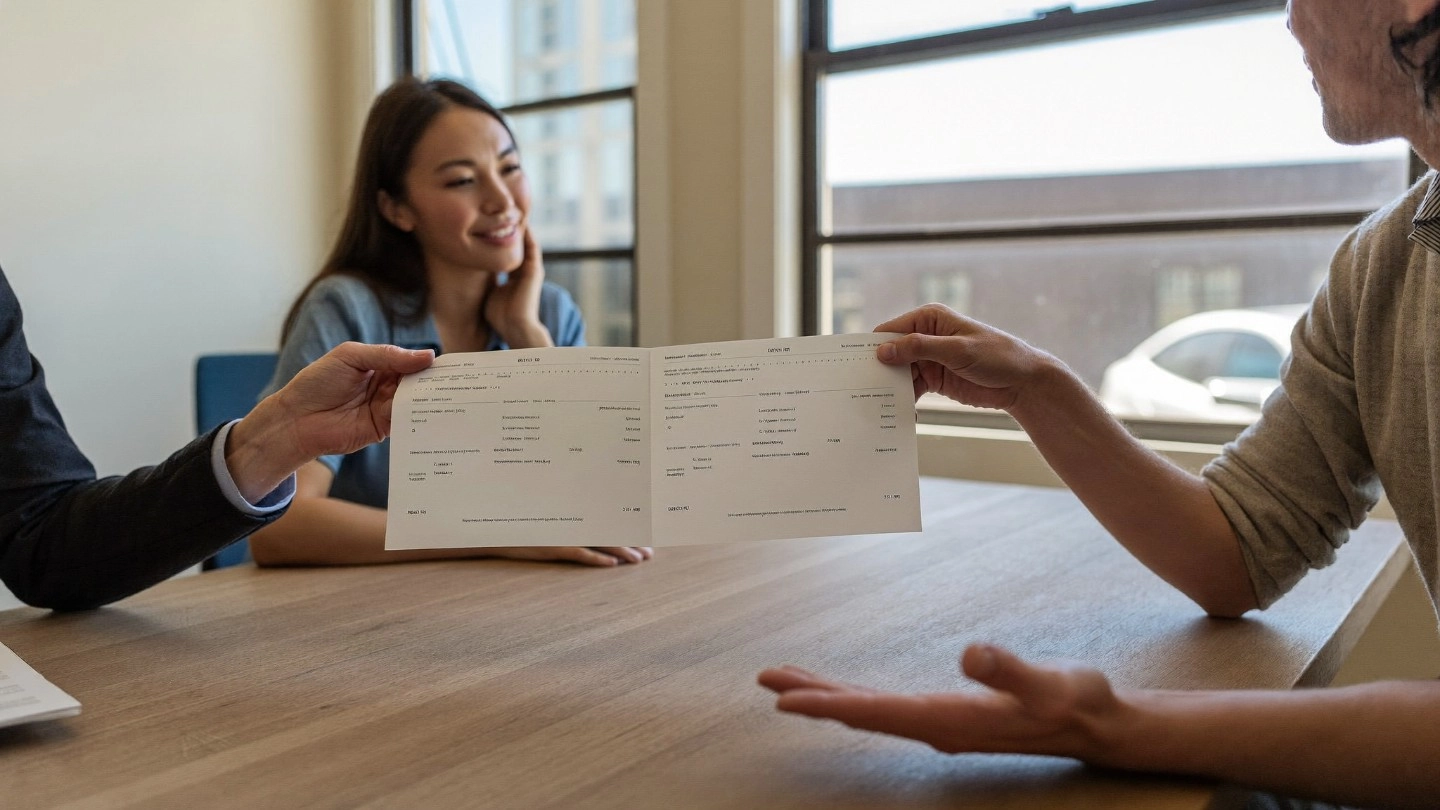
Short answer: In most Las Vegas transactions you will not write your agent a check out of pocket. Real estate commissions are paid at closing from the sale proceeds, and they usually run about 5% to 6% of the sale price split between the two sides. On a home near the local median of roughly $450,000, that is around $11,000 to $13,500 per side. Sellers typically fund it from their equity, and buyers now negotiate their agent's fee up front in a written agreement, so the exact number depends on the deal you strike.
This is the question I get more than almost any other, and I get why. Nobody wants a surprise on their closing statement. The honest answer is that "what your agent costs" depends on whether you are buying or selling, what you negotiate, and how the commission is structured. Let me walk through the real numbers for Las Vegas and Henderson so you know exactly what to expect before you ever sign anything.
What does a real estate agent actually cost in Las Vegas?
Commission is almost always a percentage of the sale price, not a flat hourly rate. Across the Las Vegas Valley, total commissions have historically landed in the 5% to 6% range, and that total is usually divided between the listing side (the seller's agent) and the buyer's side. So a common split looks like 2.5% to 3% to each side.
Here is what that means in real dollars at a few price points you actually see around here:
- A $400,000 condo in Spring Valley: at 5% total, that is $20,000 in combined commission, or roughly $10,000 per side.
- A $475,000 single-family home in North Las Vegas: at 5.5% total, about $26,125 combined, or roughly $13,000 per side.
- A $650,000 house in Summerlin or Henderson: at 5% to 6% total, somewhere between $32,500 and $39,000 combined.
Those are ranges, not fixed prices. Commission in Nevada is fully negotiable and always has been. There is no state-set rate, no rule that says it must be 6%, and no law that locks you into a number. Anyone who tells you the rate is "standard" and cannot move is not being straight with you. If you want the deeper breakdown of typical percentages here, I wrote a whole piece on how much commission real estate agents take in Nevada.
Who pays the real estate agent, the buyer or the seller?
This is where things changed recently, so pay attention to this part. For years, the seller paid both sides. The listing agreement set a total commission, and the seller's side offered a portion to whoever brought the buyer. Buyers rarely thought about it because the cost was baked into the seller's closing.
As of the industry rule changes that took effect in 2024, the process is more transparent. A few things are now true across Las Vegas:
Buyers sign a written buyer-broker agreement before touring homes. That agreement spells out exactly what the buyer's agent will be paid and who is responsible for it. Nothing is assumed anymore. Sellers still commonly offer to cover the buyer's agent fee as an incentive to attract more buyers, and in a lot of Las Vegas deals that is still what happens. But it is now a negotiated term in the contract, not an automatic default.
What this means for you in plain English: if you are selling, you decide what you are willing to offer, both for your own listing agent and toward the buyer's side. If you are buying, you agree to your agent's fee in advance, and then we work to get the seller to cover it as part of your offer. In practice, on a large share of Las Vegas transactions the buyer still pays little or nothing directly, because that cost gets negotiated into the deal. But you should never assume it. Read the agreement, ask questions, and make sure the numbers are clear before you move forward.
What does the commission actually pay for?
When people ask what an agent costs, the fair follow-up is "compared to what." A commission is not a fee for opening a door. On a real transaction, a good agent or team is handling a long list of work that protects your money and your timeline. Here is a piece of what that fee covers:
- Accurate pricing. Setting a list price or crafting an offer based on real comparable sales in your specific neighborhood, not a Zestimate. In a market like ours, pricing a Henderson home $15,000 wrong in either direction can cost you far more than the commission.
- Marketing and exposure. Professional photography, MLS syndication, staging guidance, and the network to actually get qualified buyers through the door.
- Negotiation. Managing offers, counteroffers, repair requests, and appraisal gaps. This is where a strong agent routinely saves clients more than they cost.
- Contracts and disclosures. Nevada requires specific disclosures, and the purchase agreement has real legal and financial consequences. Getting these right keeps you out of trouble.
- Transaction coordination. Riding herd on inspections, the title company, the lender, the HOA documents, and every deadline so the deal actually closes on time.
If you want the full picture of where that money goes and how agents get compensated, I broke it down in how do real estate agents get paid. The short version is that agents only get paid when the deal closes, so their incentive is lined up with yours: get you to the finish line at a good number.
Are there other fees I should expect beyond commission?
Commission is the big one, but it is not the only line item on a closing statement, and I would rather you hear this from me now than be surprised later. Depending on the deal, you may also see a broker transaction or compliance fee (often a few hundred dollars), and then the normal closing costs that come with any Nevada transaction: title insurance, escrow fees, recording fees, and prorated property taxes and HOA dues.
None of those are the agent's commission, and the closing costs exist whether you use an agent or not. The good news for Nevada buyers and sellers is that we have no state income tax and relatively modest transfer taxes compared with a lot of the country, so the overall cost to transact here is friendlier than in California or the Northeast. A trustworthy agent will hand you an estimated net sheet (for sellers) or a cost-to-close estimate (for buyers) early, so there are zero surprises at the signing table. If yours will not give you that up front, that is a red flag worth reading about in what are red flags when choosing a real estate agent.
Can I lower what I pay a real estate agent?
Yes, and you should feel free to ask. Because commission is negotiable, there is real room to talk about the rate, especially in certain situations. A higher-priced luxury home, a quick sale in a hot pocket of Summerlin, or a client doing both sides of a move (selling one home and buying another) all give you room to push on the rate. Some teams also offer reduced structures for repeat clients or for combined buy-and-sell transactions.
That said, be careful chasing the lowest possible number. The cheapest commission is not a bargain if the agent under-markets your home, misprices it, or fumbles the negotiation and leaves $20,000 on the table to "save" you $3,000. I always tell people to weigh the fee against the net result, not the fee in isolation. I dig into how to do that smartly in can I negotiate real estate agent commission. And if you want to see how a full-service team justifies its fee versus a discount model, that is exactly what we lay out on Why The Roland Team.
Is a real estate agent worth the cost?
For most people, in this market, yes. Las Vegas moves fast, inventory shifts by neighborhood, and new construction adds another layer most buyers do not fully understand. A single mistake on price, an inspection you did not know to push back on, or a bad appraisal you did not know how to handle can wipe out any commission you thought you were saving. That gap is where a good agent earns the fee several times over.
It also matters who you hire. There is a real difference between a part-time solo agent and a team with dedicated buyer specialists and seller specialists who do this every single day. Our team has closed more than 1,100 homes and earned 800+ five-star reviews from Las Vegas families, and I am proud that we rank #6 in Nevada by transaction sides (RealTrends Verified). That volume is not a vanity number. It means we have negotiated through nearly every situation the valley can throw at a deal, which is precisely what you are paying a commission to get. I cover a lot of these cost and buying questions on video too, if you want to hear it straight, over on our YouTube channel.
Whether you are buying your first place, relocating from out of state, or eyeing new construction, understanding the fee up front lets you make a clear-eyed decision. If new construction is on your radar, our Las Vegas New Construction Guide 2026 also explains how builder commissions and buyer representation work in that specific lane, which trips a lot of people up.
The bottom line
In Las Vegas, your real estate agent will most likely cost you a commission of roughly 5% to 6% of the sale price, paid at closing out of the proceeds, and split between the two sides. Sellers usually fund it from equity, and buyers now negotiate their agent's fee in writing, with the seller often covering it as part of the deal. Everything is negotiable, there is no fixed rate, and the smartest move is to weigh the fee against the net result rather than the sticker.
If you want a clear, no-pressure breakdown of exactly what a sale or purchase would cost you in your neighborhood, reach out to The Roland Team. We will run your numbers, hand you an honest net sheet, and let you decide from there. That is the whole point: you should know the cost before you commit, not after.

Mike is a Las Vegas native who has spent more than ten years helping people buy and sell across the valley. He has led The Roland Team to 1,000+ closings, and RealTrends Verified ranked him the No. 1 individual agent in Henderson and No. 6 in Nevada by transaction sides.